
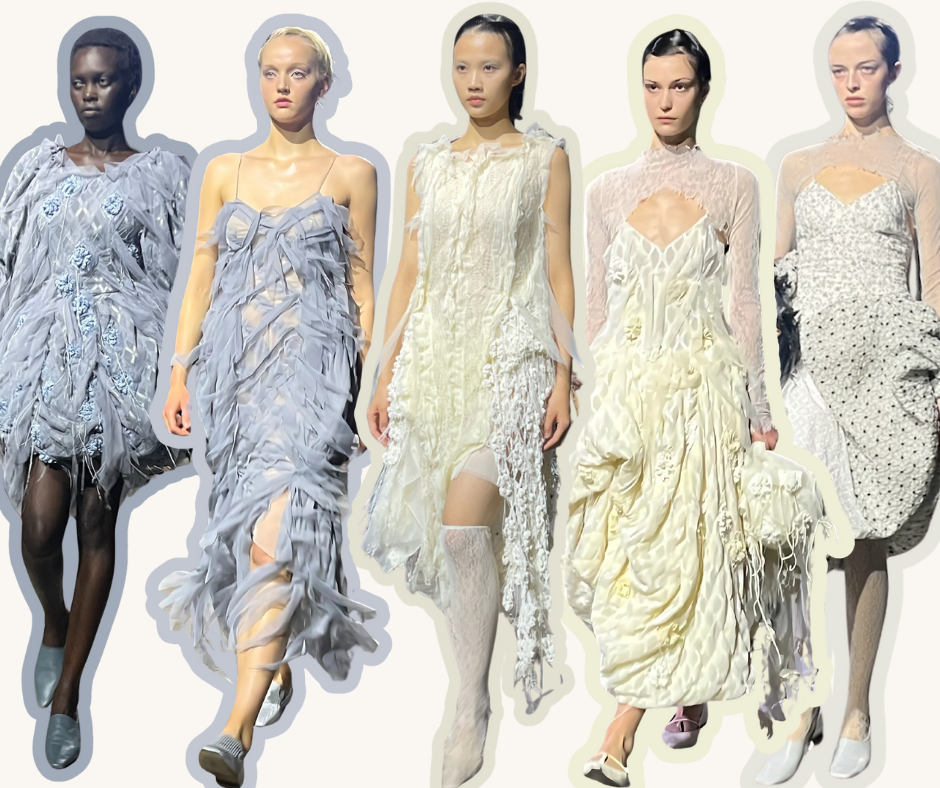

This September at London Fashion Week SS26, I was privileged to attend Pauline Dujancourt’s show on behalf of Karyatid Magazine. Hosted at 180 the Strand — the iconic headquarters of fashion week — guests were welcomed with complimentary cocktails, samples, and even facial treatments as a prelude to the presentation.
If that weren’t generous enough, we were gifted crocheted bird brooches at the door, each one uniquely handcrafted by Dujancourt herself. Their delicate ruggedness immediately captivated me, but it was the intention behind them — explained in the show notes — that moved me. Created as an ode to a close friend who passed away during the collection’s design, the brooch on my jacket took on a new weight, preparing me to read the show as a creative response to unexpected grief.
Dujancourt’s admirable ability to persevere through difficulty is mirrored in the textiles of this collection. She deliberately focused on technical two hand-knit archetypes she admits once “repelled” her: Argyle knit sweaters and crochet ‘granny squares’. Dujancourt pushed herself outside of her comfort zone without overreaching, clearly, as the pieces are works of art. Combining light yarns with strips of tulle, she wielded an expert command over unfamiliar fabrics while showcasing her personal flair.
Across 26 looks, Dujancourt sketched the non-linearity of dealing with loss, and the acceptance which must follow. Kick-starting the show was a wispy white dress that floated down the runway in swan-like fashion. I was immediately drawn to her careful juxtaposition of colour: looks one to six alternated between white and black, before blues — navy, azure, cornflower — slipped in by degrees. The effect was an immersive, artistic journey.


As Billie Eilish’s ‘everything i wanted’ rang through the dark, spotlighted room, one particular lyric stood out: ‘If I knew it all then would I do it again?” — A poignant reminder of the sacrifices Dujancourt made for this collection to materialise.
“The bird as a symbol sits at the heart of my designs,” the show notes read. Drawing inspiration from Nina’s character in Anton Chekhov’s The Seagull, to whom Dujancourt feels a nostalgic connection, avian symbols are integral to this collection’s style and storytelling. Like Nina’s resilience in times of darkness, Dujancourt’s SS26 collection is proof of her own ability to find catharsis in creation.
From handcrafting bird brooches to feathery wisps of tulle, the presentation’s narrative culminates in the final look, ‘Mother’s Dress’. Reminiscent of her mother’s own “swan-like wedding dress,” it shows Dujancourt continually refusing to shy away from intimate sources of inspiration, embracing them instead.

Alongside sheer lace sleeves, white billowing skirts, and intricately woven roses, what enamoured me most about her final look was the model’s face — an ornate tracery of lace. Creeping up from the neck, ‘Mother’s Dress’ seemed to consume her; yet her graceful determination in both expression and stride made it clear she remained in control.
Aligning with the narrative arc of her SS26 collection, the final look communicated a message of acceptance — the final stage of grief. Coinciding with the all-black ‘Mourning Dress’, the closing looks reflect one another in reverse, tying in with what Dujancourt calls “the juxtaposition of pain and joy, both markers of important moments in one’s life.”
Ultimately, Dujancourt’s choice to finish her presentation with the whiteness of ‘Mother’s Dress’ is symbolic of emerging from and overcoming darkness, and of accepting that it remains part of you. An excerpt from Jonathan Safran Foer’s Extremely Loud & Incredibly Close, printed on translucent paper and placed over the show notes, reinforced this theme of letting go both materially and symbolically.
Dujancourt’s masterful spin on knitwear has rarely felt so experimental and self-revealing. It was a pleasure to experience the show in all its curated wonder. Much like Chekhov’s Nina, Dujancourt shows that in creative expression, “life doesn’t hurt so much anymore.”
Leave a Reply